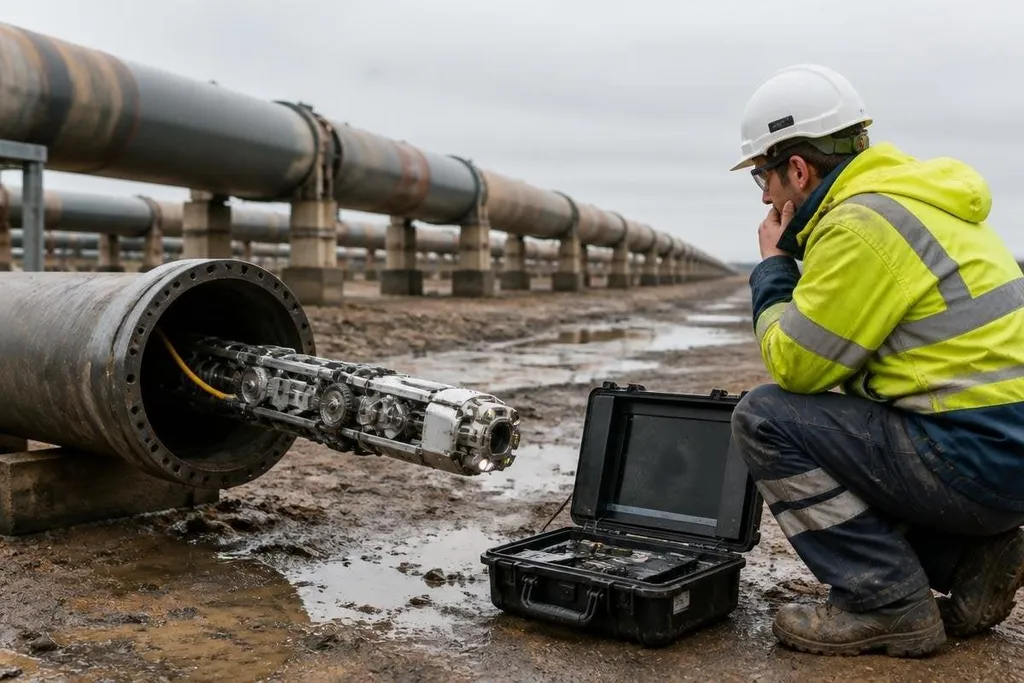
Pipeline robots already inspect pipes without sending a person into every section. Their next step will depend less on dramatic demos and more on proof that they can find faults, explain the data, and keep working in dirty conditions.
The question for an operator is practical: can a robot cut inspection risk and cost without creating a second job for the maintenance team?
Quick read
- Better sensors may help robots spot cracks, corrosion, and blocked sections.
- Autonomy will matter only when the robot can recover from poor signals and changing pipe conditions.
- Repair work still needs clear evidence, trained staff, and access to the damaged section.
What pipeline robots do now
A pipeline robot travels inside or along a pipe while sensors record the condition of the wall. Depending on the design, it may use cameras, magnetic sensors, ultrasound, or other inspection tools.
The machine’s value comes from the record it creates. An operator needs to know where a defect sits, how large it is, and whether it has changed since the last inspection. A video clip without a reliable position is hard to act on.
That makes location data as important as the sensor itself. A robot that finds a possible crack but cannot place it on the pipeline map leaves the maintenance team with more checking to do.
The next step is better data
Future systems will likely combine several sensor types during one run.
A camera can show surface damage, while magnetic or ultrasonic tools may point to faults that the camera cannot see. The exact mix will depend on the pipe material, wall thickness, contents, and access points.
Software will then need to sort the results into a usable inspection report. That means marking repeated findings, separating real defects from dirt or welds, and showing which sections need a closer look.
A pipeline operator needs the source data behind each finding. Pipeline robotics reporting can tie an inspection claim to the pipe section, test date, sensor, and measured defect, giving the report software facts it can sort before it marks unreadable areas.
A report should also show uncertainty in plain terms. If a sensor could not read one section because of speed, debris, or poor contact, the system should mark that gap instead of presenting a clean-looking report.
Autonomy has a narrow job
A robot does not need to make every decision alone. It needs to handle routine movement, keep the sensor in the right position, and stop safely when the conditions fall outside its limits.
That may include slow sections, changes in pipe shape, weak signals, or a loss of communication. A useful system can alert a remote operator and return to a known point when a run cannot continue.
Fully independent inspection remains unproven without clear field results. A controlled test section can show that a robot follows a route. It does not show that the same system works after weeks of dirt, moisture, temperature changes, and repairs inside the pipe.
I'd wait for repeated field runs before treating autonomous inspection as ready for broad use.
Repairs are a harder problem
Finding damage is only one part of the job. A repair robot must reach the area, hold its tools steady, work on a surface that may be wet or uneven, and leave a result that meets the operator’s rules.
That raises a difficult choice. A small robot may reach places that are hard for people to enter, but it may carry less power and fewer tools. A larger platform may do more work yet need a wider opening or better access.
Remote control will remain useful for these jobs. An operator can respond to conditions that the robot’s software did not predict, while sensors record the work for later review.
A buying checklist
Use these questions before a trial:
- Pipe fit: Which diameters, bends, materials, and access points can the robot handle?
- Inspection proof: Are results available from field runs, not only test sections?
- Location data: Can the system place each finding on an existing pipeline map?
- Recovery plan: What happens after a jam, signal loss, low battery, or blocked route?
- Report format: Can maintenance staff export the data into their current system?
- Repair limits: Does the robot inspect only, or can it carry out a defined repair?
The next useful proof will be a long run with a public record of faults found, missed, and checked by people. Until operators can compare those results with inspection cost and repair time, the future of pipeline robots remains a test plan, not a settled business case.